Plan your packaging line around the product, output, space and growth you need
Packaging line solutions

Complete Packaging Lines

Bring each production stage into one coordinated project. A complete line can combine container infeed, product dosing, closure application, inspection, coding, labelling, accumulation and finished-pack handling around one agreed operating brief.

UK project supportProduct and pack trialsIntegration to handover
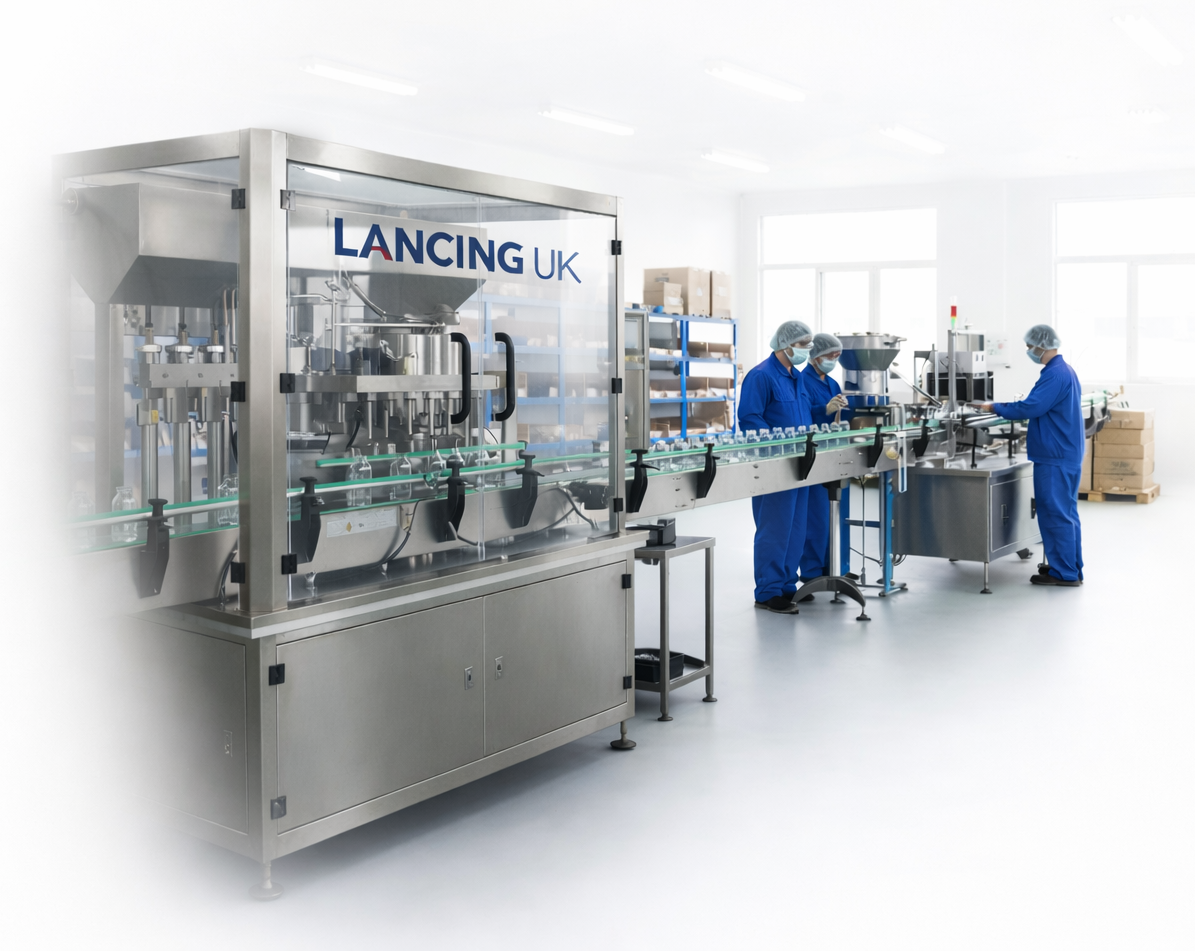
Integrated packaging production line with connected machinery and conveyors
A coordinated production route

Specify the line as one operating process

Bring each production stage into one coordinated project. A complete line can combine container infeed, product dosing, closure application, inspection, coding, labelling, accumulation and finished-pack handling around one agreed operating brief.

The engineering brief should describe the required good packs at the end of the line, not only the cycle rate of individual machines. Product behaviour, component quality, replenishment, changeovers, inspection and short stops all affect the sustainable result. The line should therefore be balanced around the real production calendar and a defined operating margin.

Start with evidence

Provide representative product, containers, closures, labels and secondary packaging from the approved range. Include the most difficult combinations, dimensional tolerances and any temperature or storage conditions that change behaviour.

Typical line stages

  1. Container feeding, rinsing or preparationDefine the incoming condition, operator activity and transfer requirements before equipment is selected.
  2. Accurate filling or dosing for the productMatch the process technology to representative product and packaging samples across the full approved range.
  3. Cap, closure, seal and tamper-evidence stagesCoordinate the mechanical and control interfaces so upstream and downstream stages recover predictably.
  4. Labelling, coding, inspection and end-of-line packingConfirm inspection, rejection, documentation and handover requirements against measurable acceptance criteria.

What shapes the final specification

These subjects should be resolved with values, samples and named responsibilities. Where uncertainty remains, the proposal should state the assumption and the test or design review that will close it.

Specification point 1

Product characteristics and cleanability

Record the operating range, difficult extremes and any allowable variation rather than supplying only a nominal value.

Specification point 2

Pack formats, change parts and SKU range

Include controlled samples, drawings or test evidence so the design basis can be verified before manufacture.

Specification point 3

Required net output rather than headline machine speed

State the required result and how it will be checked during factory and site acceptance testing.

Specification point 4

Interfaces, controls, utilities, footprint and access

Assign the interface owner and document the utilities, access, safety and maintenance implications.

Performance and acceptance

Acceptance criteria should define the tested format, material quantities, operating duration, good output, quality checks, allowable interruptions and action-closeout process. A factory acceptance test demonstrates the line before dispatch; site acceptance confirms installation, utilities, interfaces and agreed production performance in the operating environment.

One coordinated line specificationBuilt into the project brief and verified at the agreed handover stage.
Balanced stages with fewer bottlenecksBuilt into the project brief and verified at the agreed handover stage.
Clearer responsibility for integration and handoverBuilt into the project brief and verified at the agreed handover stage.
A scalable route for future formats and outputBuilt into the project brief and verified at the agreed handover stage.

Information to send with an enquiry

  • Product description, safety information and representative samples
  • Container, closure, label and case drawings or physical samples
  • Fill or pack range, target good output, batch size and shift pattern
  • Available layout, access, working heights and utility details
  • Required checks, reject handling, coding and production data
  • Installation window, training, spares and support expectations
Clear project answers

Complete Packaging Lines FAQs

What is included in a complete packaging line?

The scope can cover infeed, rinsing, filling, capping, sealing, labelling, coding, inspection, conveying, accumulation and end-of-line equipment. The final combination depends on the product and pack.

Can an existing machine be included?

Yes. Existing equipment can be surveyed and assessed for speed, controls, guarding, height and transfer compatibility before it is incorporated.

How is the correct line speed selected?

Start with the required saleable output, shift pattern, changeovers and expected efficiency. Individual machines are then sized with suitable operating margin.

Complete-line engineering

Build the project around one agreed production duty

A complete packaging line should have one controlled scope that connects process equipment, transfers, controls, safety, utilities, testing and handover. The scope matrix below helps expose assumptions before they become installation problems.

The line integrator needs a clear definition of the incoming condition and the required finished-pack condition. Product may arrive from a vessel, hopper, IBC, process line or manual feed; empty packs may be supplied in trays, cases, pallets or loose bulk; and finished packs may leave as individual containers, collations, cases or pallet-ready units. Each boundary affects equipment selection, operator work and the space required around the line.

Output should be stated as good packs produced under agreed conditions rather than the fastest published cycle rate of one machine. The specification should identify the format used for the performance run, normal replenishment tasks, planned inspection, reasonable short stops and any process condition that changes product or pack behaviour.

Four project gates for a turnkey packaging line

Each gate should leave an approved record before the next stage carries significant cost or programme risk.

Define the duty

Agree products, formats, good-output target, batch pattern, quality checks, layout, retained assets and commercial battery limits.

Approve the design basis

Review the line sequence, layout, transfers, utilities, guarding concept, controls philosophy and change-part strategy.

Prove representative operation

Run agreed samples and formats, complete FAT evidence, record settings and close actions before dispatch.

Install and hand over

Confirm site interfaces, commission the complete system, complete SAT, train users and issue the agreed documents and spares.

Complete-line scope and responsibility matrix

The responsible party will differ by project. The important point is that every boundary is named, documented and accepted rather than assumed.

Scope matrix for a complete packaging line
Scope areaDefinition requiredEvidence or boundary to agree
Product and pack supplyIncoming product condition, empty-pack presentation, closure and label replenishment, and secondary-pack supply.Minimum and maximum conditions, sample approval and responsibility for production materials.
Process modulesFilling, dosing, sealing, capping, labelling, coding, inspection and end-of-line functions included.Approved equipment duty, formats, exclusions and change parts.
Transfers and accumulationWorking heights, guide strategy, orientation, buffer purpose, reject routes and manual handling points.Layout drawing, interface heights, pack-flow review and blocked/starved response.
Controls and dataOperating modes, recipes, permissives, status signals, line stop strategy, coding data and production records.Controls philosophy, I/O boundary, network ownership and test cases.
Safety and accessGuarding boundary, interlocks, emergency functions, isolation, access for operation, cleaning and maintenance.Risk-review actions, competent-person responsibilities and final verification route.
Utilities and site worksElectrical, air, extraction, water, drainage, product services, foundations, access and lifting arrangements.Utility schedule, connection points, capacities to be confirmed and installation ownership.
Acceptance and handoverTrial quantities, FAT, SAT, quality checks, documents, training, spares and outstanding-action process.Signed protocol, results, action log and handover pack.
Machinery safety and conformity responsibilities must be explicit

The applicable duties depend on the equipment, project boundary and how the completed assembly is supplied or put into service. Do not assume that declarations for individual machines automatically cover the integrated line. Name the competent party responsible for the risk assessment, technical documentation, instructions, declaration and applicable marking route, using current GOV.UK machinery guidance and HSE work-equipment guidance for the actual project.

Buyer questions

Complete-line scope questions

How should good output be written into the specification?

State the approved format, operating period, incoming material condition, normal operator tasks, quality rules and how rejected or reworked packs are treated. This makes the result measurable without relying on an isolated machine speed.

Can existing machinery form part of a complete packaging line?

It can where condition, performance, working height, controls, guarding, documentation and spare-part support are suitable for the future duty. A survey and interface record should decide what can be retained.

What should be frozen before manufacture starts?

Freeze the design basis needed to avoid rework: approved products and packs, line sequence, key interfaces, layout, utilities, control and safety boundaries, change parts, acceptance method and named assumptions.

Turn the guidance into a project brief

Use the related pages to document the product, pack, output, layout and acceptance evidence before requesting a detailed proposal.

Turnkey project control

Control a turnkey packaging line with a deliverables and approval register

A turnkey description is only useful when the included boundary, customer inputs, site works, approval points and handover evidence are explicit. A deliverables register connects the commercial scope to the engineering records needed to build and accept the complete line.

The register should identify who prepares each item, who reviews it, the revision that is current and the decision that depends on it. This prevents an approved quotation, an early layout and a later machine drawing from becoming separate versions of the project requirement.

Approval does not need to transfer technical responsibility to the customer. It records that the stated product, pack, layout, interface or operating assumption is suitable as the basis for the next project stage. Specialist design, risk assessment and conformity responsibilities should remain with the competent parties named for the actual supply.

Deliverables and approvals for a complete turnkey packaging line
Controlled deliverableWhat it should answerApproval or release point
Production duty and format matrixProducts, packs, closures, labels, codes, secondary packaging, batch pattern, target good output and difficult operating extremes.Concept and quotation basis agreed before detailed equipment selection.
Line layout and interface drawingsEquipment sequence, working heights, pack orientation, transfers, accumulation, rejects, guarding, access and retained assets.General arrangement and principal interfaces approved before manufacture is released.
Utilities and site scheduleConnection points, site capacities to be confirmed, distribution ownership, drainage, extraction, product services, data and installation constraints.Site works can be designed and completed before equipment arrival.
Controls, quality and safety design recordsOperating modes, recipes, handshakes, stop and restart response, inspection, reject confirmation, safety boundaries and responsible specialists.Functional design is reviewed before software and integration testing are completed.
Trial and FAT evidence packApproved samples, test conditions, settings, measured results, defects challenged, actions, deviations and dispatch status.Representative operation and outstanding work are understood before shipment.
Installation, SAT and handover packAs-installed records, site test results, training, manuals, backups, spares, maintenance information and controlled remaining actions.Production handover occurs against an agreed document and acceptance status.

Link the project programme to information dependencies

A programme should state which customer information, samples, site decisions and supplier records release each activity. Dates are more dependable when they are connected to these dependencies rather than presented as an isolated lead-time promise.

Information release

Confirm the duty, controlled samples, layout data, retained assets and known site constraints.

Design approval

Close the decisions that affect frames, transfers, services, tooling, software and site works.

Integration proof

Complete representative trials, interface tests, FAT records and action review before dispatch.

Site release

Verify readiness, installation, SAT, training, documents and production-handover conditions.

Commercial boundaries that should not remain implied

  • Supply and disposal of products, packs, closures, labels, test waste and rejected material.
  • Building work, foundations, distribution of utilities, network access, extraction and drainage beyond agreed connection points.
  • Condition, modification, software access and documentation for any retained machinery.
  • Unloading, lifting, access, installation labour, production cover and attendance by customer specialists.
  • Change parts, consumables, recommended spares, backups, source access where included and post-handover support.
Turnkey line questions

Complete-line deliverables and responsibility FAQs

What does turnkey mean in a packaging-line quotation?

It should mean the supplier is responsible for the defined integrated scope through the stated handover point. The quotation still needs clear battery limits, customer inputs, exclusions, site works and acceptance conditions; the word alone does not define them.

Who should approve packaging-line deliverables?

Use the roles relevant to the decision, such as production, engineering, quality, maintenance, safety, information technology or procurement. The register should name the reviewer and record approval at the revision used for the next stage.

How should changes be handled after design approval?

Record the changed requirement, reason, technical and commercial effect, affected drawings or software, approval and implementation status. Re-test any acceptance evidence that the change makes invalid.

Compare the complete project, not only the equipment list

Use the deliverables register alongside the quotation comparison guide, the line integration scope and the FAT and SAT plan.

Your packaging line starts with the right brief

Tell us what you need to pack

Share your product, container or pack, closure, label, target output and available space. We will help you define a practical line route and the next information needed.